
Why some quantum computers need extreme cold
How cryogenic systems protect superconducting qubits, what a dilution refrigerator does, and why other quantum technologies use different environments.
Why does temperature affect a quantum computer?
Heat is motion. At ordinary temperatures, atoms, electrons, and electromagnetic fields carry enough thermal energy to disturb some of the states used as qubits. A superconducting circuit can hold quantum information only while the surrounding system keeps those disturbances under tight control.
The goal is not to make the equipment look dramatic. Cooling changes the physical behavior of the materials and lowers thermal noise. Superconducting circuits need very low temperatures to become superconducting and to keep unwanted excitations from overwhelming the small energy differences used for computation.
NIST’s overview of quantum computing describes superconducting qubits as tiny circuits made from materials that conduct without resistance at very cold temperatures. It also notes that researchers use several other kinds of qubits, each with different strengths and engineering requirements.
What does a dilution refrigerator do?
A dilution refrigerator removes heat through a series of temperature stages. The outer stages intercept heat from the room and from the wiring. Deeper stages cool the processor to a small fraction of a degree above absolute zero.
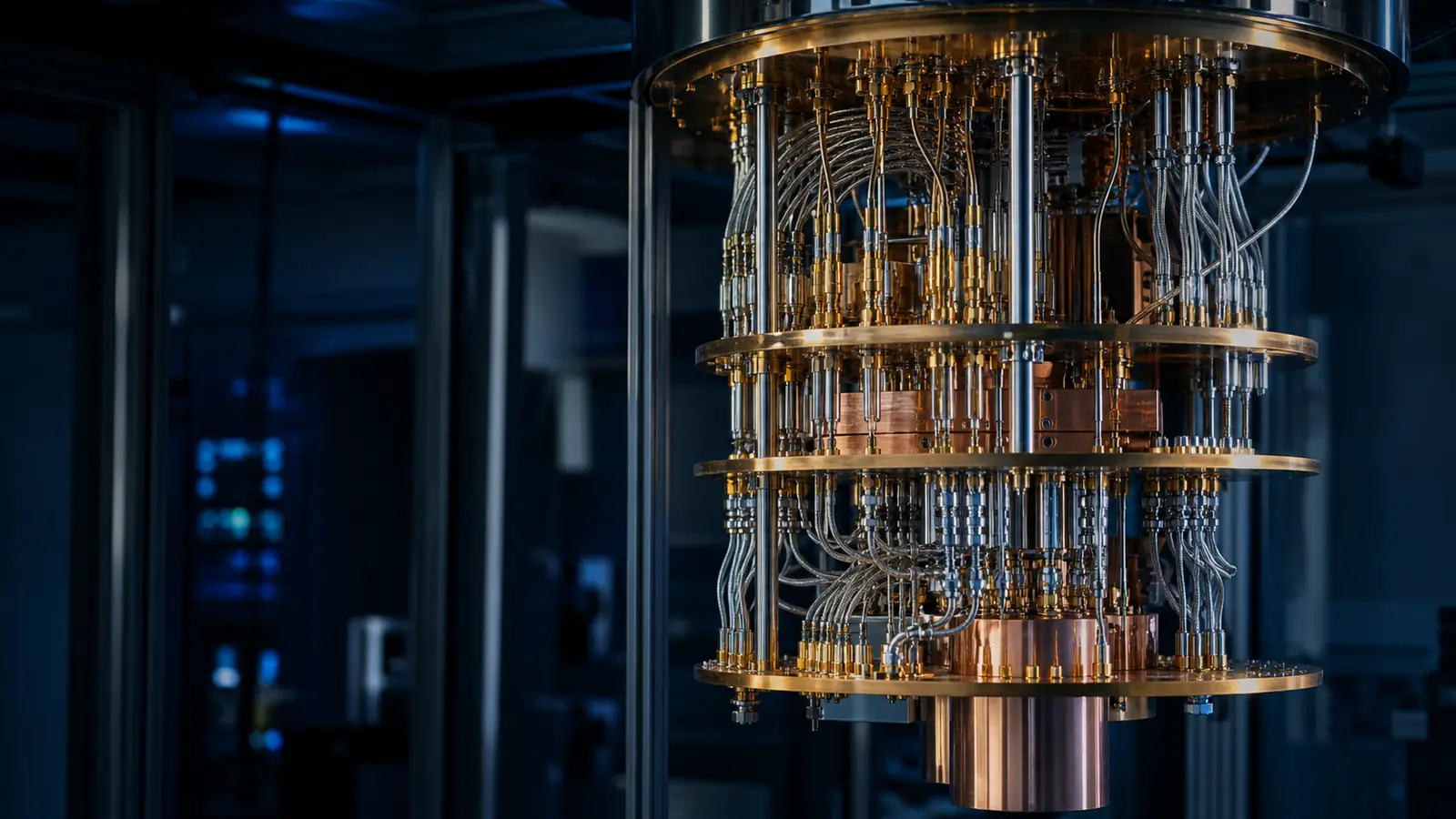
The gold and copper plates often shown in photographs are not the quantum computer by themselves. They provide thermal stages, mechanical support, shielding, and places to anchor cables. The processor sits in the coldest region, connected to room-temperature electronics by carefully designed wiring.
That connection creates a difficult tradeoff. The processor needs control and measurement signals, but every wire can also carry heat and noise toward the qubits. Engineers use attenuation, filtering, shielding, amplifiers, and staged thermal connections to manage that path.
NIST’s article Measuring Up: Coming Out from the Cold explains the challenge of linking cold qubits with control and readout systems at warmer temperatures.
Is the coldest temperature the only important number?
No. Base temperature matters, but a working system also depends on cooling power, stability, vibration, electromagnetic shielding, cable count, control electronics, calibration, and the heat introduced during operation.
A refrigerator may reach an impressive temperature while still being unsuitable for a particular processor or experiment. Each added cable, amplifier, or control component changes the thermal load. Scaling the processor can therefore require changes throughout the machine.
This is why a photograph of a refrigerator does not establish computing performance. The image shows part of the physical infrastructure. It does not show error rates, connectivity, logical qubits, algorithm performance, or how often the system must be recalibrated.
Do all quantum computers use dilution refrigerators?
No. Quantum computing is a collection of hardware approaches rather than one standard machine.
Trapped-ion systems hold electrically charged atoms using electromagnetic fields and manipulate them with lasers or microwave signals. Neutral-atom systems arrange uncharged atoms, often with optical traps. Photonic systems use particles of light. Semiconductor spin systems use quantum states in solid-state devices. These approaches have their own cooling, vacuum, optical, fabrication, and control needs.
Some components may operate near room temperature while another part of the system is cooled. Some systems rely more heavily on high vacuum and laser stability than on millikelvin refrigeration. Even within one hardware family, experimental designs can differ.
The accurate question is not “Does quantum require cold?” It is “Which physical qubit is being used, and what environment does that qubit require?”
Why is cryogenic engineering part of the quantum story?
Quantum performance depends on the complete system around the qubits. Cryogenic engineers, microwave engineers, materials scientists, control engineers, software developers, technicians, and experimental physicists may all contribute to one machine.
That matters when organizations describe jobs or products. A company selling cryogenic components may serve quantum laboratories without building a quantum processor. A software company may work with remotely hosted hardware and never operate a refrigerator. Both can be part of the field, but their roles are different.
It also matters when someone estimates cost or readiness. The processor package is only one element. Facilities, power, cooling, maintenance, calibration, and specialist labor affect whether a system can operate reliably.
What this means
Extreme cold is a practical requirement for superconducting quantum computers because it protects the physical conditions their qubits need. It is not a universal requirement for every kind of quantum technology, and it is not a performance measure on its own.
When you see a cryogenic system, treat it as a doorway into better questions. Which qubit technology is inside? What must remain cold? How are control signals delivered? What limits the system as it grows? Those questions reveal more than the familiar picture of hanging gold plates.
Editorial disclosure: This Field Note is educational. It is not an endorsement, procurement recommendation, or investment recommendation. The image is an editorial illustration and does not depict equipment owned or operated by Quantum Insiders.