
What quantum computers are good at, and what they are not ready for
What quantum computers are designed to do, why today's machines remain limited, and which claims deserve a closer look.
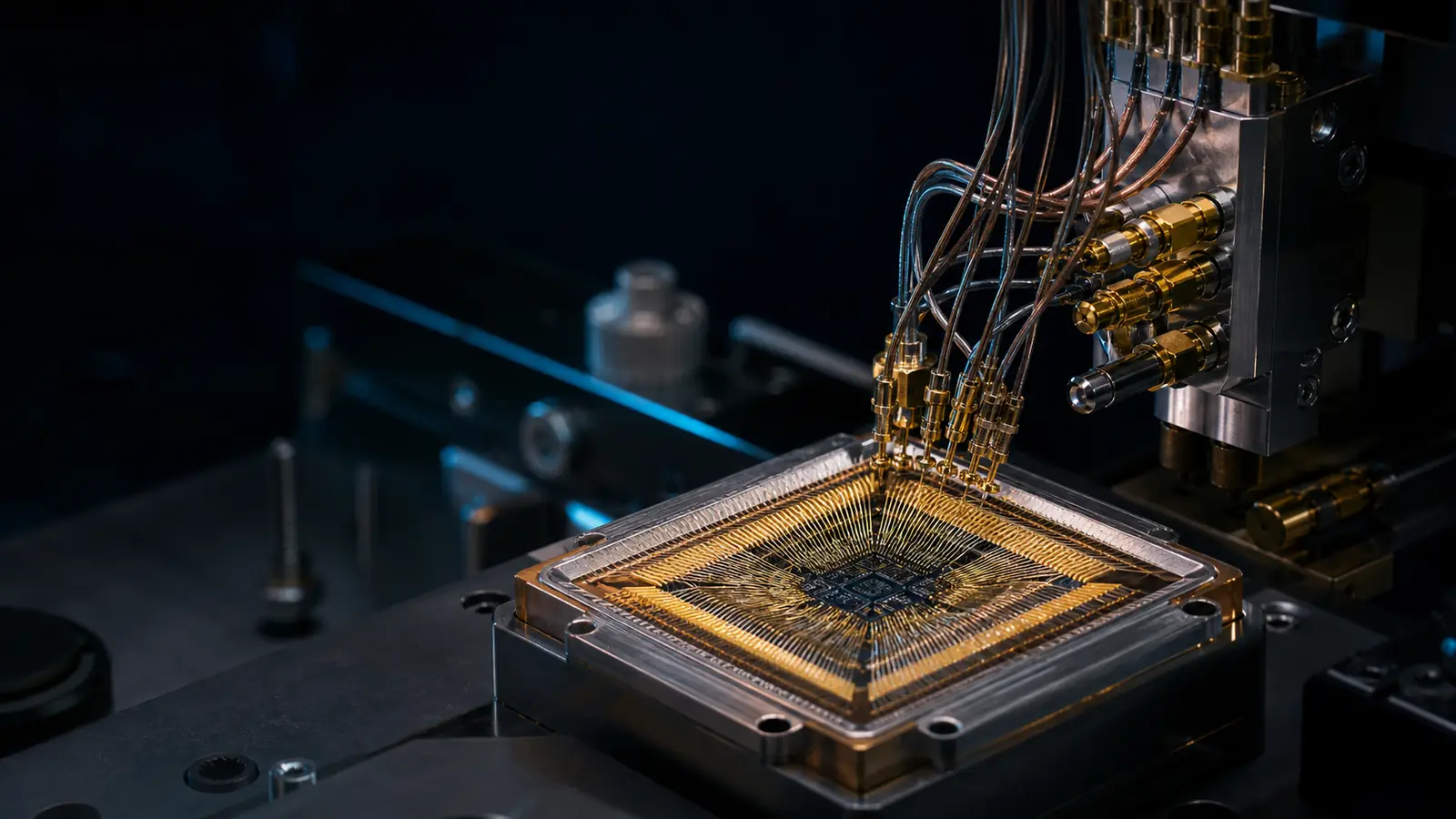
Is a quantum computer simply a faster computer?
No. A quantum computer handles information differently. That can help with certain algorithms, but it does not make every program faster. Email, accounting software, video calls, and most of the computing we use each day still belong on ordinary computers.
Ordinary computers use bits that represent either zero or one. Quantum computers use quantum bits, usually called qubits. A qubit can be prepared in a superposition, a state that combines possibilities. Qubits can also become entangled, which means their states have to be described together.
Those properties let researchers structure some calculations in new ways. They do not produce a list of every possible answer. Measuring a qubit gives limited information, so the algorithm still has to make the important pattern show up in a result we can read. NIST’s explanation of quantum computing provides a good introduction.
Which problems are researchers studying?
Researchers have designed quantum algorithms for simulation, factoring, search, and some kinds of optimization. The evidence is stronger in some areas than others.
Simulation is a natural fit because molecules and materials already follow quantum rules. A capable enough quantum computer may represent some of those systems more directly than an ordinary computer. Researchers hope this will help them study chemical reactions and materials that are difficult to model today.
Factoring is another important example. Shor’s algorithm showed that a fault-tolerant quantum computer could factor large numbers much more efficiently than known classical methods. That matters because widely used cryptography has relied on related mathematical problems. It is also why organizations are moving toward post-quantum cryptography before a cryptographically relevant quantum computer exists.
Optimization claims need extra care. Many real problems can be described as optimization, but that does not mean a current quantum machine solves them better. A fair test includes the quality of the answer, total runtime, data preparation, error handling, and the best available conventional approach.
What can today’s machines do?
Today’s quantum computers are mainly research instruments and early computing systems. They run quantum circuits, test algorithms, model physical systems, and help teams learn how the hardware behaves. Some experiments have completed narrow tasks designed to be difficult for an ordinary computer.
That is not the same as a broad commercial advantage. An experiment can prove that a machine works without showing that it improves a real business or scientific process. Conventional algorithms improve too. A task that once looked difficult can become easier when researchers find a better method.
NIST describes current machines as rudimentary and error-prone, with genuinely useful applications still dependent on more advanced and reliable systems. Its assessment of benefits and risks also separates near-term research from the capabilities expected of fault-tolerant machines.
Why do errors matter so much?
Quantum states are fragile. Heat, electromagnetic interference, imperfect control signals, and other disturbances create errors. Adding more qubits does not automatically fix the problem. The qubits must also be prepared, connected, controlled, and measured accurately enough for the calculation.
Quantum error correction addresses this by encoding one more dependable logical qubit across many physical qubits. The required overhead depends on the hardware, error rates, code, and task. This is one reason a headline qubit count is not a complete performance measure.
A careful report tells you whether the result used physical or logical qubits, how errors were handled, and how the researchers measured success.
What evidence makes a performance claim meaningful?
Begin with the problem. A serious claim states the input, the desired output, and why the task matters outside a demonstration.
Then look at the comparison. The conventional baseline should be strong, current, and tested under conditions that make the result meaningful. Be skeptical when a new machine is compared with an outdated or poorly tuned method.
Finally, look at the whole system. Preparation, repeated runs, calibration, networking, control hardware, cooling, and post-processing can affect time and cost. A processor-level timing result may still be interesting, but it should not be presented as the time required for an organization to receive a usable answer.
Useful questions include:
- What exact problem was solved?
- What classical method was used for comparison?
- Was the result reproduced by an independent group?
- Which parts of the full workflow were included?
- What changes before the result can be used outside a laboratory?
What this means
Quantum computing is not a universal speed boost, and it is not an empty idea. It has a strong scientific foundation and functioning experimental machines. It also has major engineering problems that researchers are still working to solve.
The best way to follow the field is to match the size of a claim to the evidence behind it. Ask what the machine did, what it was compared with, and what the experiment leaves unresolved. That leaves room for real progress without making one result stand for the entire field.
Editorial disclosure: This Quantum Brief is educational. It is not an endorsement, procurement recommendation, or investment recommendation.